• Skip to primary navigation
  • Skip to main content
  • Skip to primary sidebar
  • Skip to footer

Dubiln Packard

  • Home
  • About
  • Foreclosure
  • Contact

Debt Issues

August 8, 2013 by Todd Murphy

Payday Loans: The Most Despicable Loans

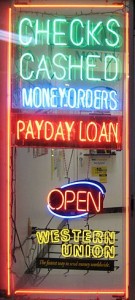
Payday_loan_shop_windowPayday loans are indeed the most despicable loans one can get and now online payday loan lending is one of the fastest growing areas of lending.

What Is A Payday Loan?

Payday loans are short-term un-secured loans to be paid back at the borrower’s next pay day.  A fee is charged at either a flat-rate or a percentage of the loan.  Most lenders don’t verify employment or income. The loan has traditionally been taken out at a store-front where the borrower writes a post-dated check for re-payment. Lately, payday lenders are increasingly going online. In an online payday loan, the cash is deposited, less the fee, directly into the borrower’s account with the expectation of re-payment on the next payday through automatic withdrawal from the borrower’s account.

A simple example: Borrow $100.  Fee of $10.  Lender gives borrower $90.  Borrower owes $100 on the next payday.  Effective interest rate 10%.

Roll-Over Is How They Get You.

The problems start when the borrower doesn’t have the money to re-pay the loan on time.   This is exactly what the lender is hoping for.  If the lender tries to cash the check, the borrower incurs bounced check fees from its bank and, worse, fees to extend the loan from the payday lender and higher interest rates.

Example continued: Borrower rolls-over the $100 loan.  Additional fee $10.  Total fees now become $20. Borrower now owes $110.  Effective interest rate 20%.

Usually what happens is the borrower knows they don’t have the cash and they contact the lender to roll-over the loan for an additional fee.  The same thing happens again and again until the borrower realizes there is just no way she can repay the loan.

Extended example: Borrower rolls-over the $100 loan a total of 5 times.  Additional fees $50.  Total fees now $60.  Borrower now owes $150.  Effective interest rate 66%

So Get Another Loan To Re-Pay The First Loan.

Once the borrower has extended the first loan a few times, she realizes she can never re-pay that first loan.  The answer, she thinks, is to take a second loan to re-pay the first.  At least that stops new fees on the first loan, right?  Wrong!  Now the process starts again on the second loan.  Fast forward a couple of weeks and now this loan can’t be re-paid either.

New example: new loan to re-pay the first $166.  Borrower receives $150. New fees $16. Effective interest rate on this new loan 10%.

Example after the roll-over: Borrower rolls-over the second loan 5 times and incurs additional fees of $80 for total fees of $96. Effective interest rate on this second loan is now 57%.  But, remember all of this went to pay the first loan of $100, no new cash was received by the borrower.  Therefore, the interest rate on that first loan of $100 is now 146%.

And Take Another Loan…

The good thing for the borrower is that payday lenders don’t check credit so they don’t know if a borrower is behind on other payday loans.  At this point, the borrow can’t pay back the second payday loan so she just takes out another one and ignores paying the first.  And so it goes until the guys who aren’t getting paid start actions to get their money.

Aggressive Collection Actions.

Payday loan lenders are some of the most unscrupulous collectors of their money on the planet.  They will resort to anything including impersonating Police or FBI officers to threatening arrest and jail time.  Eventually, a lender will sue the borrower to get a judgment then garnish the wages of the borrower for not only the originally amount but also for all of the fees owed and costs of collection including attorney fees.  You can see how ugly this can get.

Just Say No To Payday Loans.

Payday loans are the most despicable loans you could ever become involved with.  Although I know that people who resort to payday loans have trouble getting credit from traditional sources and are usually pressed for cash, there are other options.

Online Payday Lending Is Growing.

The volume of online payday lending—a term for smaller, short-term loans at high interest rates—grew to $18.6 billion in 2012, up 10% from the previous year, accounting for nearly 40% of industry-wide payday-loan volume, according to investment bank Stephens Inc.

Payday Lenders Know The Law.

Thirty-five states allow payday lending, while 15 others and the District of Columbia effectively ban such loans, mainly through interest-rate caps. But many Indian tribes have begun making loans over the Internet and argue they are sovereign states not subject to state-level regulation. Other lenders assert they don’t have to comply with state laws if they set up shop offshore or in states with favorable regulations such as Delaware and Utah.

Filed Under: Collection Defense, Debt Issues, Know your rights, Unscrupulous Collectors Tagged With: payday loans, Ripoff, unscrupulous

July 24, 2013 by Todd Murphy

What can I do if my student loan debt is high compared to my income?

If your student loan debt is high relative to your income, you may qualify for the Income-Based Repayment Plan (IBR).


Student Loan Debt: Income-Based Repayment (IBR) is designed to reduce monthly payments to assist with making your student loan debt manageable. If you need to make lower monthly payments, this plan may be for you.

To qualify for IBR, you must have a partial financial hardship. You have a partial financial hardship if the monthly amount you would be required to pay on your IBR-eligible federal student loans under a 10-year Standard Repayment Plan is higher than the monthly amount you would be required to repay under IBR. Your payment amount may increase or decrease each year based on your income and family size. Once you’ve initially qualified for IBR, you may continue to make payments under the plan even if you later no longer have a partial financial hardship. Find out whether you’re eligible.

What Typed of Loans Are Eligible For Income Based Repayment?


Most major types of federal student loans—except for PLUS loans for parents and Consolidation Loans that repaid PLUS loans for parents—are eligible for IBR.


Find out more about the William D. Ford program here: William D. Ford Direct Student Loan Program.

Filed Under: Collection Defense, Debt Issues, Learn About Loans Tagged With: student loan debt, student loans

May 28, 2013 by Todd Murphy

Medical Expenses Is Still The Number One Reason Why People File Bankruptcy

After a year-upon-year tally of the many bankruptcy cases I do each year, I have found that the number one reason why people file bankruptcy is still medical expenses.

Having extraordinary medical expenses is still the number one reason why people file bankruptcy my research shows.

A 2005 study by Harvard University showed then that 62% of bankruptcy filers filed bankruptcy due to their inability to pay enormous medical expenses after a significant illness or injury.  My own records show this still to be true.

Cancer Takes A Financial Toll.

Of the most financially devastating diseases, cancer reigns supreme. The American Cancer Society estimates that the 2010 total cost of cancer in the U.S. rose to $263.8 billion. So perhaps unsurprisingly, a new study by the Fred Hutchinson Cancer Research Center shows a close link between cancer diagnosis and personal bankruptcy. Compared to the general population, bankruptcy rates are nearly twice as high among cancer patients one year after diagnosis.  Of the bankruptcies caused by a cancer, a surprising 78% reported having some form of health insurance.

Many Are Covered By Health Insurance.

Overall, three-quarters of the people with a medically-related bankruptcy had health insurance.

I found a very high percentage of people who filed had health insurance, but many of them were bankrupted anyway because there were gaps in their coverage like co-payments and deductibles and uncovered services.  Other people had private insurance but got so sick that they lost their job and lost their insurance.

Many middle-class Americans feel insulated from these growing costs by medical insurance, but often when serious medical problems arise, that safety net either disappears or proves to be full of holes.

For Most, Health Insurance Is Employer Based.

For most, medical insurance is employer-sponsored. That means the insurance can disappear when illness or injury makes working impossible.

Although COBRA laws allow the employee to extend the insurance coverage by assuming payments, that solution falls short for many. COBRA can be very expensive and coverage is limited in duration, so an illness or injury that prevents work in the long-term will ultimately outlast those benefits.

Even people with active medical insurance coverage often end up with large bills as co-payments, non-covered services and other out-of-pocket expenses mount.

Although many policies include “catastrophic” provisions that limit out-of-pocket expenses, the cut-offs are often so high that policyholders are bankrupted by the medical expenses that fall in the gap.

These radically mounting medical bills haven’t been absorbed easily by the average American family.

Filed Under: Bankruptcy FAQ, Collection Defense, Debt Issues, Financial Healing Tagged With: medical bankruptcy

May 28, 2013 by Todd Murphy

Top 5 Reasons People File Bankruptcy

There many reasons people file bankruptcy.  Here are the Top 5 reasons people file bankruptcy.

1. Medical Expenses.

One of the biggest reasons people file bankruptcy is for medical expenses. A study done a few years ago at Harvard University indicates that this is the biggest cause of bankruptcy, representing 62% of all personal bankruptcies. It is interesting to note the study shows that 78% of filers had some form of health insurance.

Rare or serious diseases or injuries can easily result in hundreds of thousands of dollars in medical bills – bills that can quickly wipe out savings and retirement accounts, college education funds and home equity. Once these have been exhausted, bankruptcy may be the only shelter left, regardless of whether the patient or his or her family was able to apply health coverage to a portion of the bill or not.

2. Job Loss.

Another very significant reason people file bankruptcy is due to job loss.  Whether due to layoff, termination or resignation, the loss of income from a job can be devastating. Some are lucky enough to receive severance packages, but many find pink slips on their desks or lockers with little or no prior notice. Not having an emergency fund to draw from only worsens this situation, and using credit cards to pay bills can be disastrous. This isn’t just something for the low-wage worker.  A middle class family with a $3000 p/mn mortgage, two car payments of $300 each along with all of the regular day-to-day expenses won’t last long without a steady income – even with some savings.  Bankruptcy can put debts on ice giving you time to find a job and keep your family from having to live on the street.

The loss of insurance coverage and the cost of COBRA insurance also drain the job seeker’s already limited resources. Those who are unable to find similar gainful employment for an extended period of time may not be able to recover from the lack of income in time to keep the creditors at bay.

3. Mismanagement of Credit.

A third reason people file bankruptcy is due to mismanagement of credit.  Some people simply can’t control their spending. But credit card companies make it worse by giving easy credit and increasing limits when they see heavy use.  Credit card bills, installment debt, car and other loan payments can eventually spiral out of control, until finally the borrower is unable to make even the minimum payment on each type of debt. And, even if the borrower made the minimum payments, at the high interest rates credit card companies charge, once the balance gets high, the minimum payments don’t even cover the monthly interest digging the borrower deep into a hole. If the borrower cannot access funds from friends or family or otherwise obtain a debt-consolidation loan, then bankruptcy is usually the inevitable alternative.

Debt-consolidation and home equity loans make it worse.

Statistics indicate that most debt-consolidation plans fail for various reasons, and usually only delay filing for most participants. Home-equity loans make things worse by turning unsecured debt into secure debt putting your home at risk of foreclosure on their homes if they are unable to make this payment as well.

Borrowing from 401k and pensions is wrong.

Some people, in an effort to “do the right thing” and pay debts, resort to raiding thee own retirement accounts.  DO NOT. Many people are unaware that funds in retirement savings are protected in bankruptcy allowing you to get rid of the bad debts but keep your hard-earned retirement savings that you will not be able to replace.

4. Divorce or Separation.

Another reason people file bankruptcy is after divorce or separation. Marital dissolutions create tremendous financial strain on both partners in several ways. First come the legal fees, which can be astronomical in some cases, followed by a division of marital assets, decree of child support and/or alimony, and finally the ongoing cost of keeping up two separate households after the split. The legal costs alone are enough to force some to file, while wage garnishments to cover back child support or alimony can strip others of the ability to pay the rest of their bills. Spouses who fail to pay the support dictated in the agreement often leave the other completely destitute.

5. Unexpected Expenses.

Loss of property due to theft or casualty, such as earthquakes, floods or tornadoes for which the owner is not insured can force some into bankruptcy. Many homeowners are likely unaware that they must take out separate coverage for certain events such as earthquakes. Those who do not have coverage for this type of peril can face the loss of not only their homes but most or all of their possessions as well. Not only must they then pay to replace these items, but they must also find immediate food and shelter in the meantime. Furthermore, those who lose their wardrobes in such a catastrophe may not be able to dress appropriately for their work, which could cost them their jobs.

If you have debts that are out of control, don’t do anything until you understand all there is to know about bankruptcy.  It is a federal law that is designed to help you.  It is not wrong to file bankruptcy.


Filed Under: Bankruptcy FAQ, Collection Defense, Debt Issues, Featured Tagged With: reasons for bankruptcy

May 10, 2013 by Todd Murphy

Chase Abusive On Debt Collection Of Credit Cards

Chase Sued For Abusive Debt Collection Of Credit Cards: And People Are Told Bankruptcy is bad?

In just one more incident of big banks or credit card companies using abusive methods on debt collection of credit cards, JPMorgan Chase was sued in California Court alleging that Chase committed abuses against tens of thousands of California consumers for debt collection credit cards.

These guys don’t care how they get their money.

According to California Attorney General Kamala D. Harris, for about three years, between January 2008 and April 2011, Chase filed thousands of lawsuits each month to collect soured credit card debt, Ms. Harris said. On a single day, for example, Chase filed 469 lawsuits, court records show.  Ms. Harris said, Chase took shortcuts like relying on court documents that were not reviewed for accuracy. “To maintain this breakneck pace,” according to the lawsuit, Chase relied on “unlawful practices.”

Abuses are rampant.

JPMorgan Chase is already navigating a thicket of regulatory woes. The Office of the Comptroller of the Currency, one of the bank’s chief regulators, is preparing an enforcement action against the bank over the way it collects its credit card debt, according to several people close to the matter who spoke on the condition of anonymity because they were not authorized to discuss the cases publicly.

Chase assembled a “debt collection mill that abuses the California judicial process,” according to the lawsuit. Many of the lawsuits filed rely on questionable or incomplete records, Ms. Harris said. “At nearly every stage of the collection process,” the bank “cut corners in the name of speed, cost savings and their own convenience,” she said.

Bankruptcy Is Just A business Tool To Help You Get Back On Track.

Bankruptcy is a business tool used by savvy people and businesses to help get back on track once debt becomes unmanageable.  Companies, sports and entertainment figures, and regular people all over the Country use bankruptcy for what it was intended to be used for: protect companies and individuals with too much debt and restore their ability to regain financial health and become a part of the economy once again. Don’t feel badly about using the tool for savvy people.

Todd Murphy is a NJ Bankruptcy Lawyer practicing in Somerville, NJ.  He can be reached at 862-217-2361.

Filed Under: Collection Defense, Debt Issues, Unscrupulous Collectors Tagged With: Chase, Credit Cards, debt collection

« Previous Page
Next Page »

Primary Sidebar

(862) 305-4901

Search This Site

Footer

American Bankruptcy Institute Logo National Association of Consumer Advocates Logo
Avvo - Rate your Lawyer. Get Free Legal Advice.
Designated A Debt Relief Agency Under U.S.C. 528
( see required bankruptcy disclosures )
The materials available at this web site are for informational purposes only and not for the purpose of providing legal advice. You should contact your attorney to obtain advice with respect to any particular issue or problem. Use of and access to this Web site or any of the e-mail links contained within the site do not create an attorney-client relationship between Todd Murphy Law and the user or browser.
Lawyer J Murphy | Featured Attorney Foreclosure
(862) 217 2361