• Skip to primary navigation
  • Skip to main content
  • Skip to primary sidebar
  • Skip to footer

Dubiln Packard

  • Home
  • About
  • Foreclosure
  • Contact

Collection Defense

Are collectors after you?

You can protect your assets while you reorganize your finances.
Your rights are clear under the law. Let the law protect you while you restructure debt and take control of your situation.

October 15, 2013 by Todd Murphy

Can I Discharge Debt with Chapter 13?

You can discharge debt with Chapter 13 bankruptcy, and keep your assets.

Chapter 13 Bankruptcy is essentially a repayment program.  If you follow the repayment schedule that you and your attorney set up with the court, your unsecured debt is discharged at the end of the program.  That means that credit card debt, medical debt, and other unsecured debt (we’ll talk about secured v. unsecured in a moment) is considered no longer yours if you successfully complete the Chapter 13 plan.

Secured debt is debt that is backed by a physical object such as a home or a car.  These types of debt you must continue to pay on your Chapter 13 schedule.  Unsecured debt is the kind of debt that is NOT backed by a valuable physical object, such as credit cards, medical debt, store cards, furniture, etc.  During your Chapter 13 plan, you do not make payments toward your unsecured debt.

During your Chapter 13 plan, you MUST make 50 payments towards your SECURED debt ON TIME in order for you to complete the plan and get your unsecured debt discharged.  Todd Murphy, NJ Bankruptcy Lawyer, recommends that you set aside some emergency money so that you can ALWAYS make your SECURED debt payments ON TIME and complete your Chapter 13 plan, so that you can get your unsecured debt discharged.

Todd Murphy, NJ Bankruptcy Lawyer, will work with you to asses what is called your “disposable income”.  This is the income you have leftover at the end of the month after you pay your living expenses.  Your disposable income should be enough to pay your SECURED debt payments like your mortgage or car payment.  After you make 50 on-time payments, you will have successfully completed your Chapter 13 plan and you will be free of your unsecured debt!

Contact Todd Murphy to find out if you qualify for a Chapter 13 Bankruptcy plan.
Filed Under: Bankruptcy as an Option, Bankruptcy FAQ, Collection Defense, Debt Collection FAQ, Learn About Loans Tagged With: eliminate debt, void debt

August 28, 2013 by Todd Murphy

Western Sky To Stop Payday Lending

Western Sky On-Line Payday Lender To Stop Making Loans!

I have written about payday loans many times and it always disturbs me to see what sharks these guys are. As a bankruptcy lawyer in New Jersey, I often see people who are in financial distress turn to some pretty unsavory companies.  Payday lenders are the scum of the earth and the damage inflicted because of such loans is nothing short of terrible.

Lately there has been a good deal of press about payday lenders with several states launching investigations and other actions.  Today, one of those companies, Western Sky Financial, says it will stop making loans.  As reported in The Washington Post an other news services that Western Sky will no longer be making their ultra high interest loans after September 3 as a result of governmental enforcement actions.

As being reported in the Wall Street Journal, several states have filed enforcement actions against Western Sky alleging that its loans violate state licensing and lending laws.  Western Sky contended that it was a entitled to tribal immunity because one of its owners is a member of the Cheyenne River Sioux tribe.  To date, every court that has considered this proposition has rejected Western Sky’s claim that it is entitled to tribal immunity.

Unfortunately, even though Western Sky says it will stop making loans, there are a large number of “loans” still outstanding.  If you have a payday loan from an out-of-state lender or an on-line lender, you should consult with a lawyer in your area to see if that loan is also illegal.

Considering bankruptcy?  Todd Murphy, a NJ Bankruptcy Attorney, is the New Jersey Bankruptcy Lawyer people have trusted for over 15 years for Chapter 7 Bankruptcy and Chapter 13 Bankruptcy.  Our office is conveniently located to serve all of Essex County, Bergen County, Passaic County, Hudson County, Union County, Morris County, and Middlesex County.

Filed Under: Collection Defense, Featured, News, Unscrupulous Collectors Tagged With: payday loans

August 21, 2013 by Todd Murphy

Fight Collection Abuse

The Fair Debt Collection Practices Act helps protect consumers and fight collection abuse.  New Jersey bankruptcy firm Todd Murphy Law can help protect you from questionable or harassing debt collection practices.

The Fair Debt Collection Practices Act (FDCPA) prohibits the debt collector from contacting a third party (someone who has information about you) if they know that you are represented by a lawyer.  If you do not have a bankruptcy lawyer, the debt collector can only contact third parties to locate you.  Your New Jersey bankruptcy lawyer will inform your debt collectors that he/she is representing you.

A debt collector must inform you in every communication they have with you that the communication is from a debt collector.  The debt collector is required to send you a dispute/verification invitation within five days of their first contact with you.  If you submit a dispute within 30 days, the debt collector must stop trying to collect until the debt is verified.

Telephone calls from a debt collector to you must only occur between 8:00am and 9:00pm.  They cannot call you at work if there is an employer policy against such types of calls.

A debt collector must not harass, oppress, or abuse a consumer.  This is not well defined in the law, however, and is left to the courts to decide.  If there is abuse, try to record abusive collection language when you hear it, and keep a record of the calls in writing what took place and how it made you feel.  The more proof of the abuse you have the better, as it can be difficult to convince a judge or jury that abuse took place.

Debt collectors are not permitted to use false or misleading information to collect a debt, and may not collect more than what is owed.

If a debt collector violates any part of the FDCPA, you may be able to recover actual damages, $1000 in statutory penalties, and attorney fees.

We’re here to help protect against collection abuse practices. If you’re abused by a collector, contact an attorney immediately.

Call Todd Murphy Law today for a free consultation.

Filed Under: Collection Defense, Debt Issues, Featured, Know your rights, Unscrupulous Collectors Tagged With: Abusive Lenders, debt collection

August 8, 2013 by Todd Murphy

Payday Loans: The Most Despicable Loans

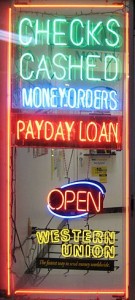
Payday_loan_shop_windowPayday loans are indeed the most despicable loans one can get and now online payday loan lending is one of the fastest growing areas of lending.

What Is A Payday Loan?

Payday loans are short-term un-secured loans to be paid back at the borrower’s next pay day.  A fee is charged at either a flat-rate or a percentage of the loan.  Most lenders don’t verify employment or income. The loan has traditionally been taken out at a store-front where the borrower writes a post-dated check for re-payment. Lately, payday lenders are increasingly going online. In an online payday loan, the cash is deposited, less the fee, directly into the borrower’s account with the expectation of re-payment on the next payday through automatic withdrawal from the borrower’s account.

A simple example: Borrow $100.  Fee of $10.  Lender gives borrower $90.  Borrower owes $100 on the next payday.  Effective interest rate 10%.

Roll-Over Is How They Get You.

The problems start when the borrower doesn’t have the money to re-pay the loan on time.   This is exactly what the lender is hoping for.  If the lender tries to cash the check, the borrower incurs bounced check fees from its bank and, worse, fees to extend the loan from the payday lender and higher interest rates.

Example continued: Borrower rolls-over the $100 loan.  Additional fee $10.  Total fees now become $20. Borrower now owes $110.  Effective interest rate 20%.

Usually what happens is the borrower knows they don’t have the cash and they contact the lender to roll-over the loan for an additional fee.  The same thing happens again and again until the borrower realizes there is just no way she can repay the loan.

Extended example: Borrower rolls-over the $100 loan a total of 5 times.  Additional fees $50.  Total fees now $60.  Borrower now owes $150.  Effective interest rate 66%

So Get Another Loan To Re-Pay The First Loan.

Once the borrower has extended the first loan a few times, she realizes she can never re-pay that first loan.  The answer, she thinks, is to take a second loan to re-pay the first.  At least that stops new fees on the first loan, right?  Wrong!  Now the process starts again on the second loan.  Fast forward a couple of weeks and now this loan can’t be re-paid either.

New example: new loan to re-pay the first $166.  Borrower receives $150. New fees $16. Effective interest rate on this new loan 10%.

Example after the roll-over: Borrower rolls-over the second loan 5 times and incurs additional fees of $80 for total fees of $96. Effective interest rate on this second loan is now 57%.  But, remember all of this went to pay the first loan of $100, no new cash was received by the borrower.  Therefore, the interest rate on that first loan of $100 is now 146%.

And Take Another Loan…

The good thing for the borrower is that payday lenders don’t check credit so they don’t know if a borrower is behind on other payday loans.  At this point, the borrow can’t pay back the second payday loan so she just takes out another one and ignores paying the first.  And so it goes until the guys who aren’t getting paid start actions to get their money.

Aggressive Collection Actions.

Payday loan lenders are some of the most unscrupulous collectors of their money on the planet.  They will resort to anything including impersonating Police or FBI officers to threatening arrest and jail time.  Eventually, a lender will sue the borrower to get a judgment then garnish the wages of the borrower for not only the originally amount but also for all of the fees owed and costs of collection including attorney fees.  You can see how ugly this can get.

Just Say No To Payday Loans.

Payday loans are the most despicable loans you could ever become involved with.  Although I know that people who resort to payday loans have trouble getting credit from traditional sources and are usually pressed for cash, there are other options.

Online Payday Lending Is Growing.

The volume of online payday lending—a term for smaller, short-term loans at high interest rates—grew to $18.6 billion in 2012, up 10% from the previous year, accounting for nearly 40% of industry-wide payday-loan volume, according to investment bank Stephens Inc.

Payday Lenders Know The Law.

Thirty-five states allow payday lending, while 15 others and the District of Columbia effectively ban such loans, mainly through interest-rate caps. But many Indian tribes have begun making loans over the Internet and argue they are sovereign states not subject to state-level regulation. Other lenders assert they don’t have to comply with state laws if they set up shop offshore or in states with favorable regulations such as Delaware and Utah.

Filed Under: Collection Defense, Debt Issues, Know your rights, Unscrupulous Collectors Tagged With: payday loans, Ripoff, unscrupulous

August 8, 2013 by Todd Murphy

Can I Be Arrested For Not Paying Pay Day Loans?

telephone-in-handsI have had many calls asking: Can I be arrested for not paying pay-day loans?

The short answer is “No.”

A few clients have told me that they’ve received phone calls from a collection agency, threatening jail time for not repaying payday loans. The typical caller identifies himself as a “federal officer” who will be coming to arrest the borrower in the next few hours unless payment is made by phone immediately. Another version involves telling the borrower that criminal charges have been filed in a distant state and the borrower must show up “next week.”

Some of these calls are scams just trying to rip you off while others are actually pay-day loan collectors trying to trick you into paying with these scare-tactics.

If you get one of these calls, don’t try to settle things with the caller and don’t offer to make any payments. The threats violate the law and you may be entitled to sue for damages. However, the callers are usually located in an overseas call center, so attempting to enforce the FDCPA is next to impossible.

It is not uncommon for scammers to make illegal threats in order to collect a debt. If you have been contacted by a phony or a harassing debt collector, contact a local attorney for help in dealing with these people.

The FBI is aware of these scams and has posted an alert on their scam alert website. See below.

From FBI website.

02/21/12—The Internet Crime Complaint Center (IC3) continues to receive complaints from victims of payday loan telephone collection scams. As previously reported in December 2010, the typical payday loan scam involves a caller who claims the victim is delinquent on a payday loan and must make payment to avoid legal consequences.

Callers pose as representatives of the FBI, “Federal Legislative Department,” various law firms, or other legitimate-sounding agencies and claim to be collecting debts for companies such as United Cash Advance, U.S. Cash Advance, U.S. Cash Net, or other Internet check-cashing services. The fraudsters relentlessly call the victim’s home, cell phone, and place of employment in attempts to obtain payment. The callers refuse to provide information regarding the alleged payday loan or any documentation and become verbally abusive when questioned.

The IC3 has observed variations of this scam in which the caller tells the victim that there are outstanding warrants for the victim’s arrest. The caller claims that the basis of the warrants is non-payment of the underlying loan and/or hacking. If it’s the latter, the caller tells the victim that he or she is wanted for hacking into a business’ computer system to steal customer information. The caller will then demand payment via debit/credit card; in other cases, the caller further instructs victims to obtain a prepaid card to cover the payment.

The high-pressure collection tactics used by the fraudsters have also evolved. In one recent complaint, a person posed as a process server and appeared at the victim’s job. In another instance, a phony process server came to a victim’s home. In both cases, after claiming to be serving a court summons, the alleged process server said the victim could avoid going to court if he or she provided a debit card number for repayment of the loan.

If you are contacted by someone who is trying to collect a debt that you do not owe, you should:

  • Contact your local law enforcement agencies if you feel you are in immediate danger;
  • Contact your bank(s) and credit card companies;
  • Contact the three major credit bureaus and request an alert be put on your file;
  • If you have received a legitimate loan and want to verify that you do not have any outstanding obligation, contact the loan company directly;
  • File a complaint at www.IC3.gov.

Filed Under: Collection Defense, Know your rights Tagged With: fdcpa, pay day loans, Ripoff, scams

« Previous Page
Next Page »

Primary Sidebar

(862) 305-4901

Search This Site

Footer

American Bankruptcy Institute Logo National Association of Consumer Advocates Logo
Avvo - Rate your Lawyer. Get Free Legal Advice.
Designated A Debt Relief Agency Under U.S.C. 528
( see required bankruptcy disclosures )
The materials available at this web site are for informational purposes only and not for the purpose of providing legal advice. You should contact your attorney to obtain advice with respect to any particular issue or problem. Use of and access to this Web site or any of the e-mail links contained within the site do not create an attorney-client relationship between Todd Murphy Law and the user or browser.
Lawyer J Murphy | Featured Attorney Foreclosure
(862) 217 2361